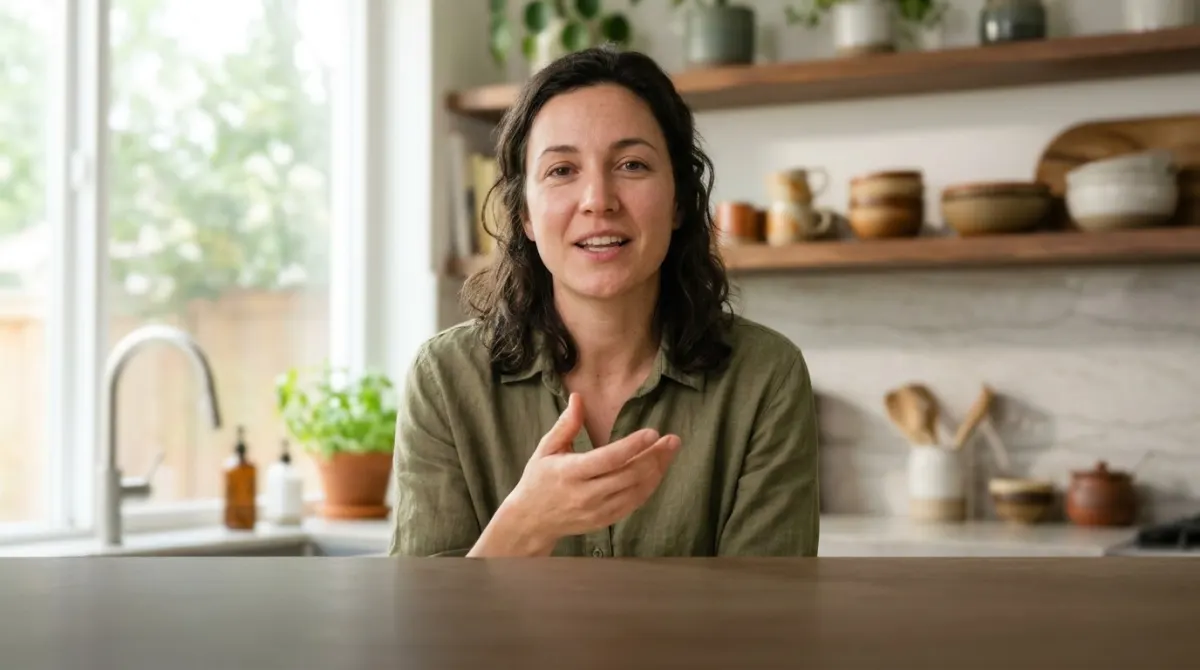
A six-person panel discussion, and it kept every voice straight. I stopped double-checking after the third transcript.
Portuguese Transcription: Brazilian and European Portuguese to Text
Say the same sentence in São Paulo and in Lisbon and many of the vowels change: Portugal swallows unstressed vowels that Brazil pronounces in full. Upload a recording and get a Portuguese transcript with every tilde and cedilla in place, speakers labelled and each line timestamped.
MP3, WAV, MP4, MOV & more · files up to 8 GB · no credit card needed
Every word, in Portuguese
interview.mp3PT
Inês
Reformamos o estúdio no inverno.
Rui
Desde então, cada episódio soa mais quente.
Inês
As pessoas percebem na hora.
Click or drag & drop to upload your audio or videoTap to upload your audio or video
MP3, MP4, M4A, MOV, AAC, WAV, OGG, OPUS, MPEG, WMA, WMV
No credit card required · Files encrypted · Never used for AI training
What Makes Portuguese Hard to Transcribe


In Lisbon, unstressed vowels shrink or disappear, so telefone can come out close to “t’lefon’”, and a syllable-final s becomes the “sh” sound known as chiado, which Rio speakers share. In most of Brazil the vowels stay full, and de and te are often pronounced “dji” and “tchi”. The model is trained on Portuguese speech from Brazil, Portugal and other Portuguese-speaking countries, and you do not have to say which variety you recorded.
A Brazilian says estou fazendo and waits for the ônibus; in Portugal it is estou a fazer and the autocarro. A celular in São Paulo is a telemóvel in Porto. The transcript does not convert one variety into the other: a Brazilian speaker comes out in Brazilian Portuguese and a speaker from Portugal in European Portuguese, which is what quotes, research and subtitles need.
Tildes mark nasal vowels (mãe, põe, irmã), ç keeps the c soft before a, o and u (cabeça, açúcar), and one accent can separate two words: in Brazil tem (“has”) and têm (“have”) sound alike, while avó and avô are grandmother and grandfather. Spelling follows the 1990 Orthographic Agreement, but some words are still written differently in each country, such as facto and fato or receção and recepção, so check those against the standard you publish in.
What a Clean Portuguese Transcript Looks Like
Three lines from a conversation between a Brazilian and a Portuguese speaker.
- Speaker 1
A gente estava conversando sobre isso quando o ônibus chegou.
Brazilian Portuguese as spoken: the informal word for “we”, the gerund and the Brazilian word for bus. Nothing has been rewritten into European usage.
- Speaker 2
Estávamos a falar disso quando o autocarro chegou.
The same idea from a speaker in Portugal, with the infinitive construction instead of the gerund and the European word for bus. Words stressed on the third-last syllable always carry an accent, so a missing one is easy to spot.
- Speaker 1
As vendas subiram 12,5% e agora eles têm três lojas.
The verb takes a circumflex because the subject is plural, although in Brazil it sounds just like the singular. Figures use the decimal comma, which is worth checking before the text goes into a report.
How to Transcribe Portuguese Audio
From a Portuguese recording to editable text in three steps.
Transcribe Portuguese Audio30 free minutes · No credit card
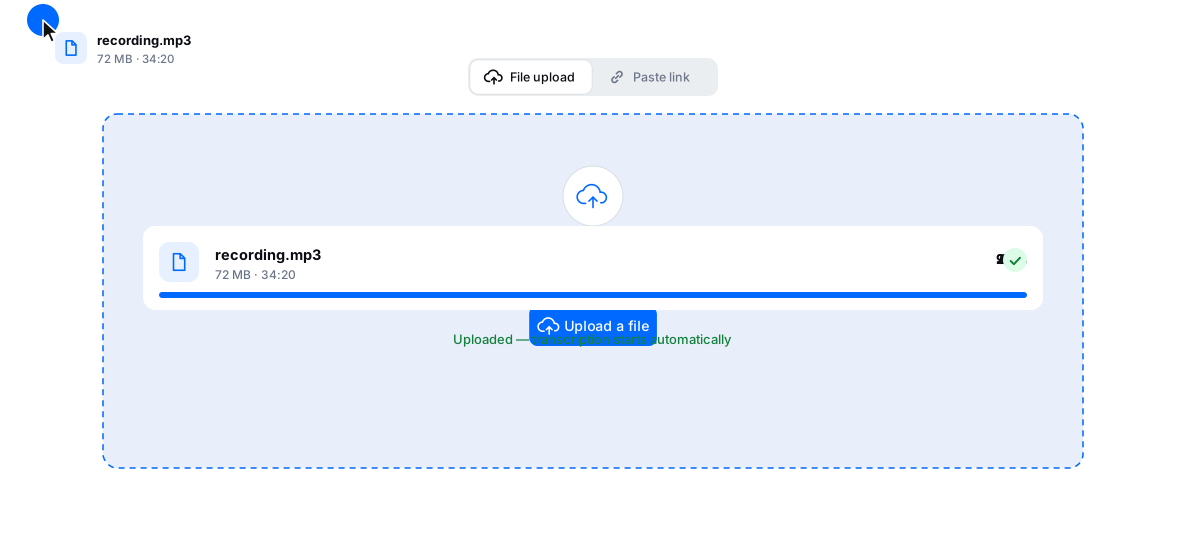
Add an MP3, WAV, M4A, MP4, MOV or other common file, or paste a YouTube or Vimeo link.
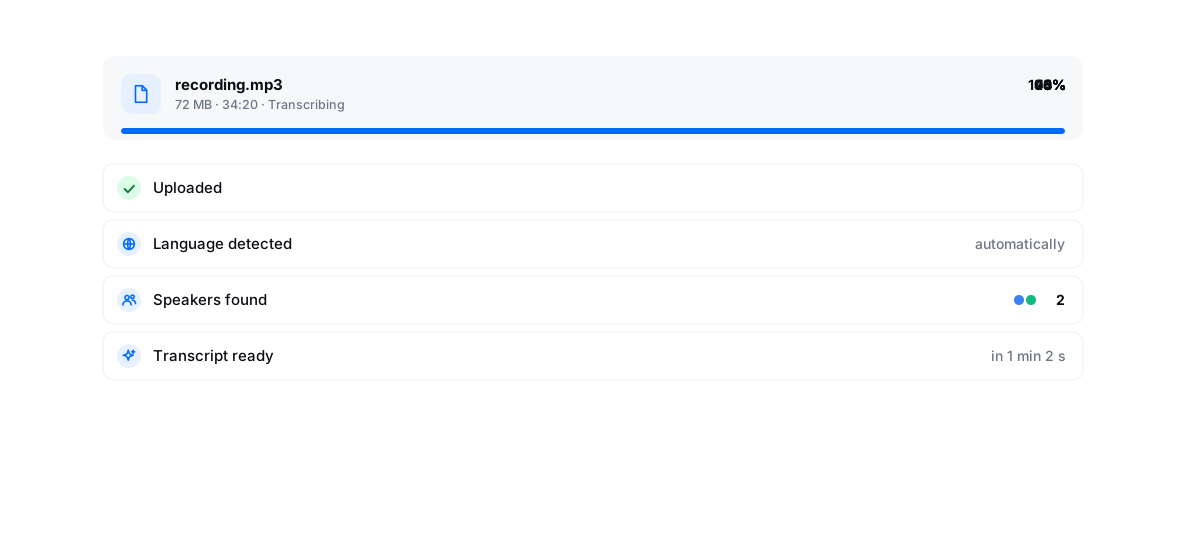
Auto-detection listens to several stretches of speech across the file. If the recording starts with music, an English intro or a Spanish speaker, choose Portuguese yourself. One Portuguese setting covers Brazil and Portugal.
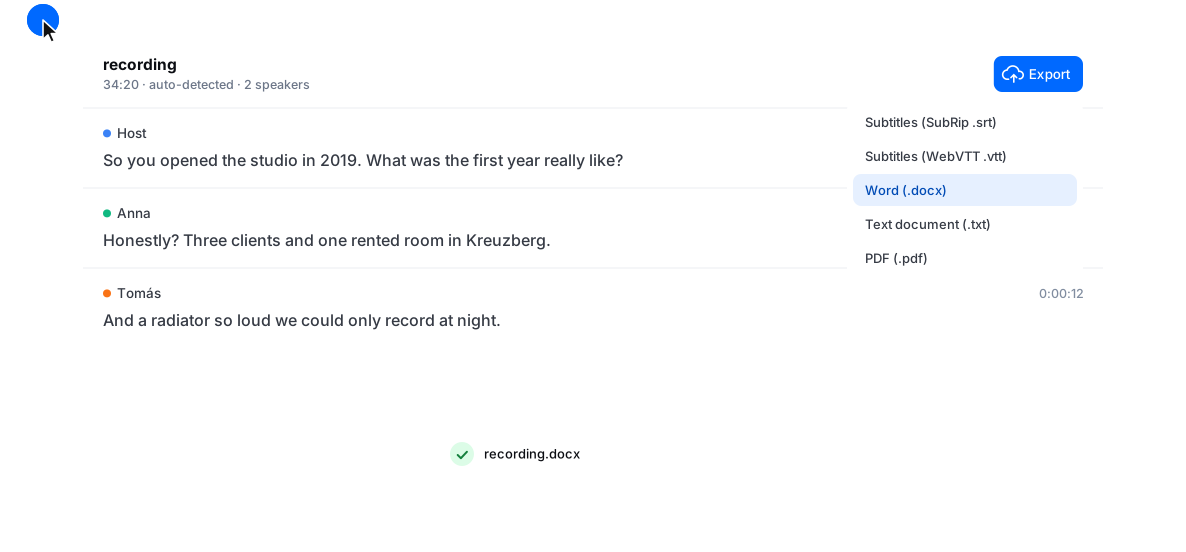
Check accent marks, names and figures, correct anything in the editor, then export SRT, VTT, ASS, TXT, DOCX, PDF, CSV, XLSX or JSON.
Why Transcribe Portuguese with BlaBlaScribe
One tool for Brazilian and European Portuguese.
Brazil, Portugal and beyond
São Paulo, Lisbon, Luanda or Maputo: accents are recognised as spoken, with no variety to pick first.
Speakers labelled for you
Interviews, focus groups and podcasts come back as a dialogue, each turn marked with its speaker.
Portuguese subtitles in the same place
Turn the transcript into timed subtitles split into lines that are comfortable to read on screen.
Into 50+ languages, or dubbed
Translate the transcript or subtitles, or dub the video into English and 25 other languages with an AI voice.
Loved by Creators, Teams and Researchers
Rated Excellent 4.8/5 based on 580+ reviews
Other tools gave me a lowercase stream of words. Here sentences actually read like sentences — barely any cleanup.
No card, no tricks — I tested real files before paying and upgraded a week later because the workflow stuck.
Had trouble with a huge file — support walked me through batch upload the same morning. Rare these days.
Field interviews go in as MP3s and come out as clean DOCX with timestamps. My write-up time dropped by half.
Uploaded a two-hour recording during lunch — the transcript was waiting before I finished my coffee. The accuracy genuinely surprised me.
Our legal team approved it because processing stays on EU infrastructure. That alone ruled out most of the competition.
Upload a Portuguese audio or video file up to 8 GB, or paste a link from YouTube or another site. BlaBlaScribe’s AI turns the speech into text with speaker labels and timestamps; on clear recordings, accuracy reaches up to 99.8%. Check the transcript against the audio in the editor, then export TXT, DOCX, PDF, CSV, XLSX, JSON, SRT, VTT or ASS. The first 30 minutes are free, no credit card required.
Yes, with a single Portuguese setting. The model is trained on speech from Brazil, Portugal and other Portuguese-speaking countries, so it recognises both pronunciations without being told which one it is hearing. There is no separate variety to select.
No. The transcript keeps the words and grammar the speaker used: estou fazendo stays estou fazendo, autocarro stays autocarro. If the text has to follow one variety, for example for a publication in Portugal, adapt it in the editor afterwards.
Spelling follows the 1990 Orthographic Agreement. Where Brazil and Portugal still write a word differently (facto/fato, receção/recepção, António/Antônio), either form may appear, so if you work to a house standard, check those words before you publish.
For interviews, lectures, podcasts, meetings and videos, an AI transcript plus a short review in the editor covers most needs, and it is ready in minutes. There is no human proofreading, so for certified legal or court transcripts use a specialised service.
Up to 99.8% on clear audio, with Portuguese punctuation, accents and capitalisation. Background noise, overlapping voices and phone-quality recordings lower it, and the editor makes the remaining fixes quick.
All common audio and video formats — MP3, WAV, M4A, MP4, MOV, MKV and more — up to 8 GB per file, or a YouTube or Vimeo link. Export to SRT, VTT, ASS, TXT, DOCX, PDF, CSV, XLSX or JSON.
Yes. You get 30 free minutes once, with no credit card: short Portuguese recordings are transcribed in full, long ones show the first 10 minutes.