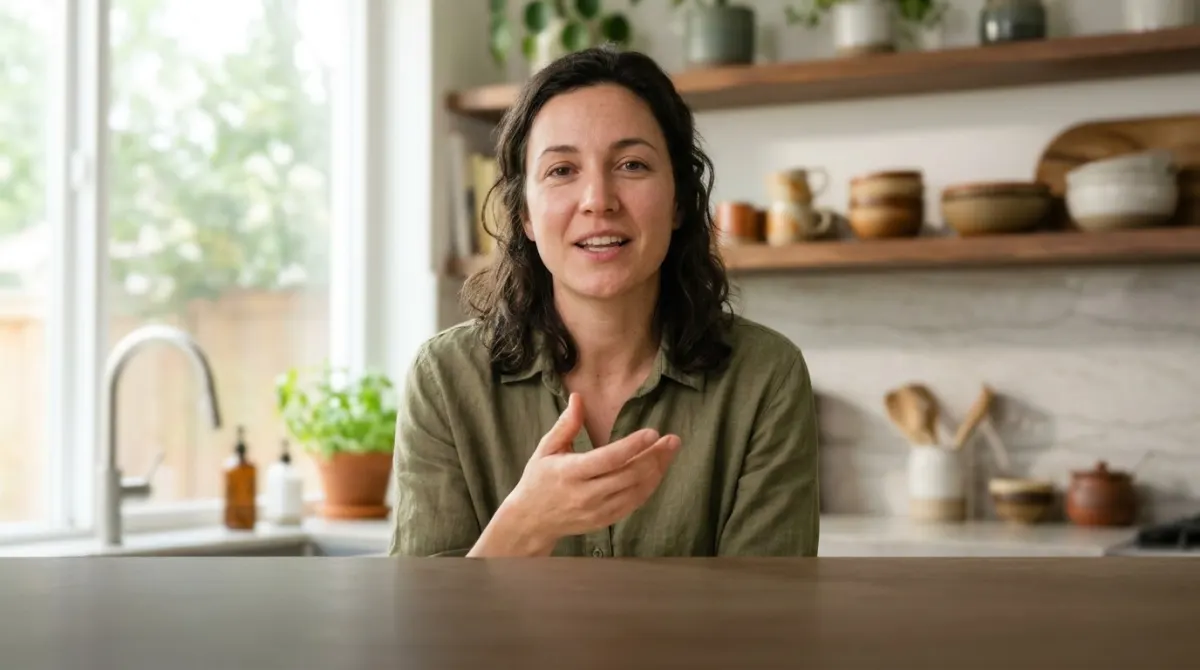
A six-person panel discussion, and it kept every voice straight. I stopped double-checking after the third transcript.
Japanese Transcription: Japanese Audio and Video to Text
Written Japanese mixes three scripts and puts no spaces between words, so a transcript is a string of choices the audio alone cannot make. Upload a recording and get Japanese text written from context, with speakers labelled and every line timestamped.
MP3, WAV, MP4, MOV & more · files up to 8 GB · no credit card needed
Every word, in Japanese
interview.mp3JA
さくら
冬にスタジオを作り直しました。
健太
それ以来、どのエピソードも温かく聞こえます。
さくら
聴く人はすぐに気づきます。
Click or drag & drop to upload your audio or videoTap to upload your audio or video
MP3, MP4, M4A, MOV, AAC, WAV, OGG, OPUS, MPEG, WMA, WMV
No credit card required · Files encrypted · Never used for AI training
What Makes Japanese Hard to Transcribe


Japanese has a small set of syllables and a huge number of homophones. Kikai can be 機械 (machine) or 機会 (chance); kōen can be 公園, 講演 or 公演. The audio is identical, so the kanji have to be picked from the rest of the sentence. Names of people and companies are the hardest case, because their readings often cannot be guessed at all.
The same word can be written in kanji, hiragana or katakana: 下さい or ください, 出来る or できる. Choices like these are usually a matter of style, so a transcript may not match your house rules. There are also no spaces between words, which matters for subtitles: a line has to break where it still reads naturally, not in the middle of a word.
Keigo changes the verb itself: 言います, おっしゃいます and 申します all mean “say”, at different levels of respect. A transcript has to keep the level the speaker used, because in an interview or a business meeting it carries meaning. Sentence-final particles such as ね and よ, and fillers like えーと and あの, are part of how Japanese is spoken.
What a Clean Japanese Transcript Looks Like
Three lines from a meeting, and what each one shows.
- Speaker 1
この機械を使う機会は、正直あまりないですね。
The words for machine and opportunity are both read kikai. Only the meaning separates them, and homophones like these are the first thing worth checking in a Japanese transcript.
- Speaker 2
それでは、詳しいところは部長からご説明いただきます。
The honorific form is kept exactly as spoken. A plain form would change who is being shown respect.
- Speaker 1
えーと、参加者は去年より三割ほど増えて、1,200人でした。
Fillers can stay for research or come out for subtitles. Numbers may appear in kanji or in Arabic digits, so pick one style before the text is published.
How to Transcribe Japanese Audio
From a Japanese recording to editable text in three steps.
Transcribe Japanese Audio30 free minutes · No credit card
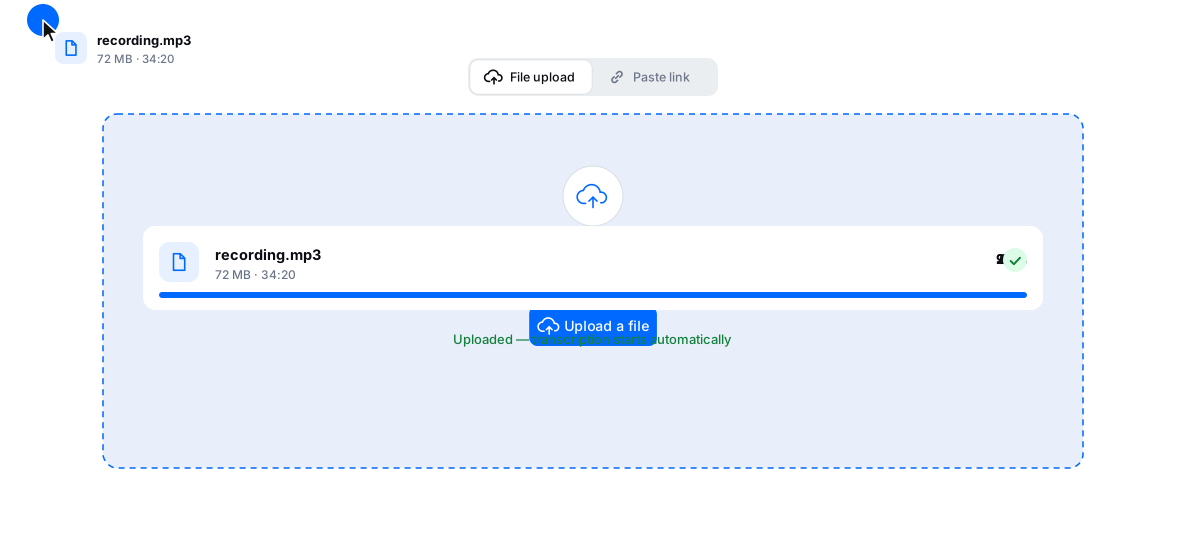
Drop in MP3, WAV, M4A, MP4, MOV or any common format, or paste a YouTube or Vimeo link.
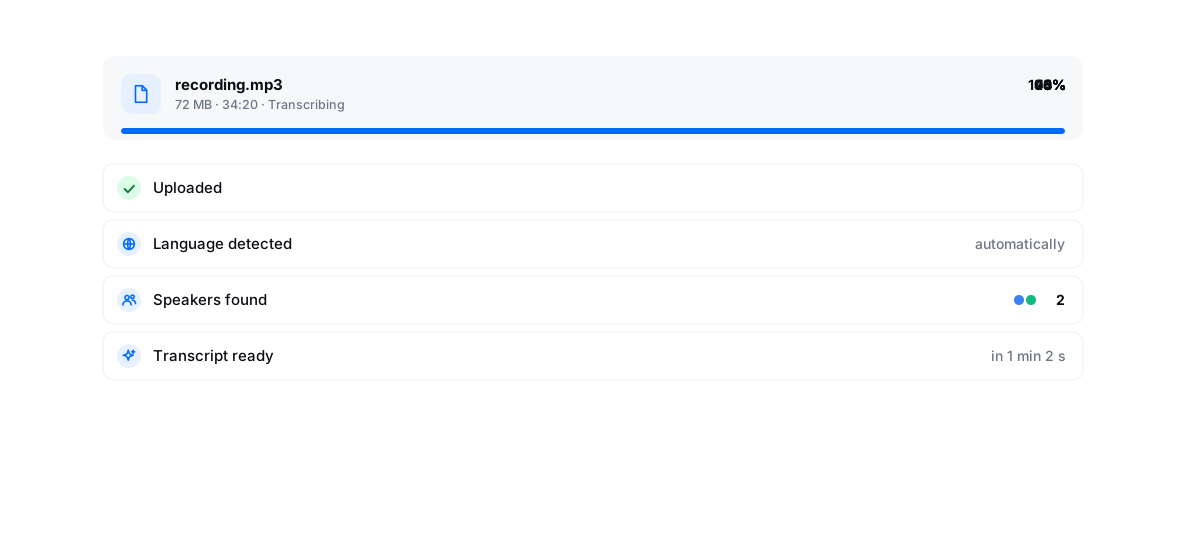
Auto-detection listens to several stretches of speech across the file. If the video opens with music or an English introduction, select Japanese yourself.
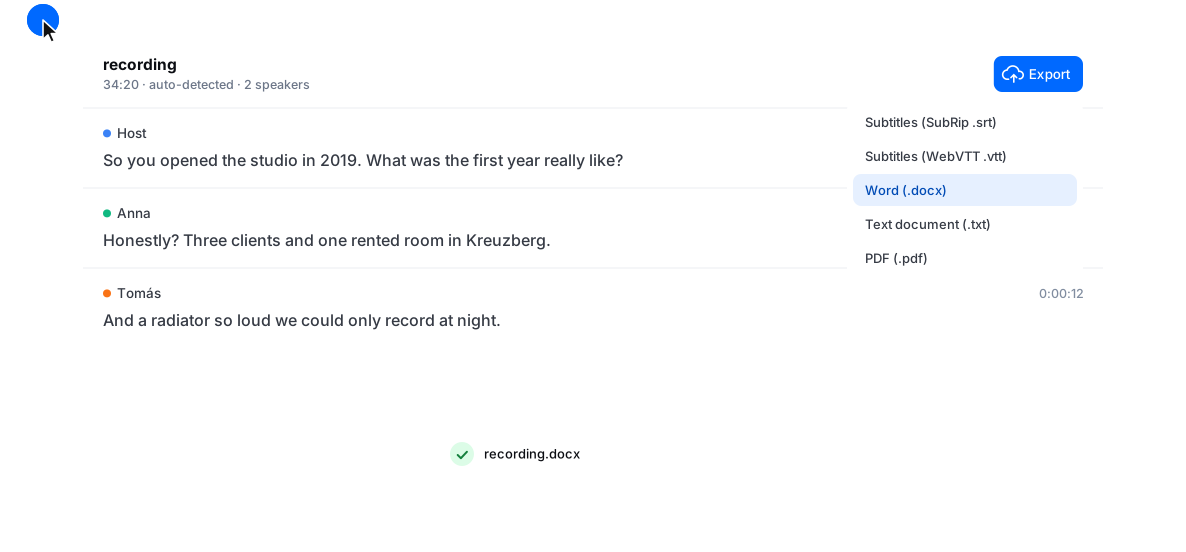
Read through names, homophones and numbers, fix anything in the editor, then export SRT, VTT, ASS, TXT, DOCX, PDF, CSV, XLSX or JSON.
Why Transcribe Japanese with BlaBlaScribe
Built for Japanese as it is actually spoken.
Japanese script, not romaji
The transcript is written in kanji and kana, with Japanese punctuation, ready to edit and publish.
Who said what
Speakers are labelled automatically, so a meeting or an interview reads as a dialogue, not a wall of text.
Japanese subtitles from the same file
Turn the transcript into timed subtitles, then adjust line breaks in the editor where the meaning needs it.
From Japanese to 50+ languages
Translate the transcript or subtitles, or dub the video into English and 25 other languages.
Loved by Creators, Teams and Researchers
Rated Excellent 4.8/5 based on 580+ reviews
Other tools gave me a lowercase stream of words. Here sentences actually read like sentences — barely any cleanup.
No card, no tricks — I tested real files before paying and upgraded a week later because the workflow stuck.
Had trouble with a huge file — support walked me through batch upload the same morning. Rare these days.
Field interviews go in as MP3s and come out as clean DOCX with timestamps. My write-up time dropped by half.
Uploaded a two-hour recording during lunch — the transcript was waiting before I finished my coffee. The accuracy genuinely surprised me.
Our legal team approved it because processing stays on EU infrastructure. That alone ruled out most of the competition.
Upload a Japanese audio or video file up to 8 GB, or paste a link from YouTube or another site. BlaBlaScribe’s AI turns the speech into text with speaker labels and timestamps; on clear recordings, accuracy reaches up to 99.8%. Check the transcript against the audio in the editor, then export TXT, DOCX, PDF, CSV, XLSX, JSON, SRT, VTT or ASS. The first 30 minutes are free, no credit card required.
Homophones are written from the meaning of the sentence, so common words usually come out right. Names of people, places and companies are different: many have several possible readings, so check them against your own list before you publish.
Yes. The transcript follows the speech, so honorific and humble forms such as いらっしゃいます or 申します stay as the speaker used them. That matters for interviews, business meetings and anything quoted later.
Spoken Japanese is full of them. Some may appear in the transcript and quick ones may be left out, so it is not a verbatim record of every hesitation. For subtitles, remove the rest in the editor; for research, listen through the passages that matter.
Up to 99.8% on clear audio, with Japanese punctuation. Background noise, overlapping speakers and phone-quality recordings lower it, and the editor shows text and audio side by side, so the remaining fixes are quick.
Yes. Create Japanese subtitles from the same file, then translate them into English or 50+ other languages with the timing kept. You can also dub a Japanese video into English, or an English one into Japanese, with an AI voice.
All common audio and video formats — MP3, WAV, M4A, MP4, MOV, MKV and more — up to 8 GB per file, or a YouTube or Vimeo link. Export to SRT, VTT, ASS, TXT, DOCX, PDF, CSV, XLSX or JSON.
Yes. You get 30 free minutes once, with no credit card: short Japanese recordings are transcribed in full, long ones show the first 10 minutes.