Transcript Examples and Templates
A transcript is the spoken words written down, usually with who said them and when; below are examples of the common formats, and you can export any of them from your own recording.
Export TXT, DOCX, PDF, SRT, VTT, CSV, XLSX or JSON from one transcript
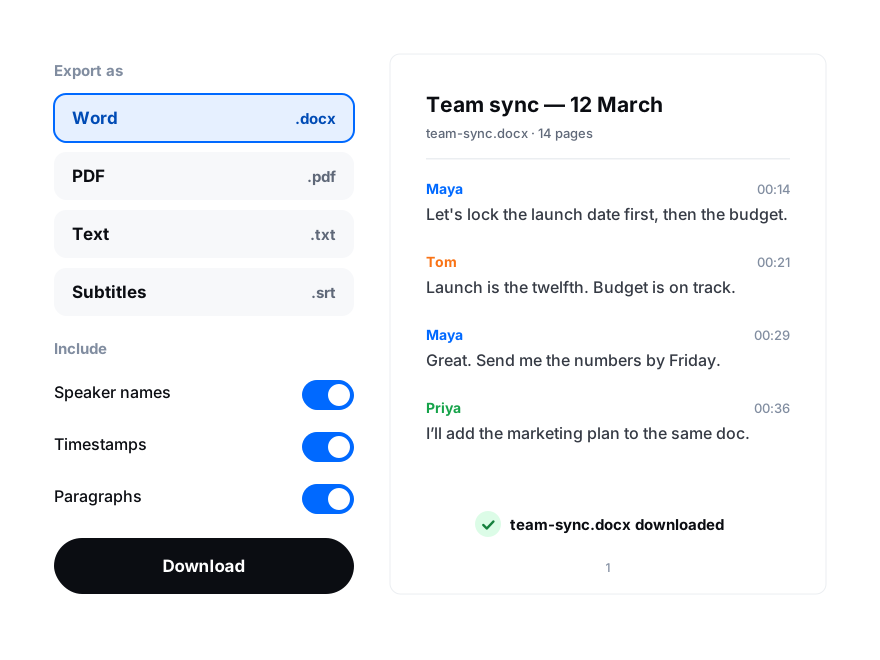
One transcript, many formats
interview-dana.docx
Dana (12:46 - 12:52)
I wanted to build one product, not forty pitches.
interview-dana.csv
Start, End, Text
12:46, 12:52, I wanted to build one product, not forty pitches.
interview-dana.srt
214
00:12:46,100 --> 00:12:49,800
I wanted to build one product,
Click or drag & drop to upload your audio or videoTap to upload your audio or video
MP3, MP4, M4A, MOV, MKV, WEBM, AVI, WAV, FLAC, AAC, OGG, OPUS, WMA, WMV
No credit card required · Stored in the EU · Never used for AI training
Which Transcript Format Do You Need?


A document with speaker names and occasional timestamps: interviews, meetings, podcasts.
One turn per row with start and end times, ready for coding in a spreadsheet or analysis software.
Subtitle files with timed cues that players and editors read: SRT and VTT.
Transcript Examples by Format
Illustrative excerpts showing how the same kind of content looks in each format.
- Interview (clean verbatim)
- Interviewer (00:12:40): What made you leave the agency? / Dana (00:12:46): I wanted to build one product, not forty pitches.
- Full verbatim
- Dana: I, um, I wanted to — to build one product, you know, not forty pitches. [laughs]
- Meeting
- Anna [00:04:10]: Can we move the launch to May? / Jonas [00:04:16]: Only if the budget is set by Friday.
- Spreadsheet (CSV)
- Start, End, Text → 4:10, 4:15, Can we move the launch to May?
- Subtitles (SRT)
- 1 / 00:00:01,800 --> 00:00:03,600 / Film the hook first.
- Plain text
- The words only, no names or times: for notes, articles and search.
Format Choices to Make
Decide these before you send a transcript to anyone.
Verbatim
Clean or full verbatim?
Clean verbatim drops ums and false starts and reads well; full verbatim keeps every hesitation for legal or linguistic work. AI transcripts here are close to clean verbatim.
Timestamps
How often?
Every line for analysis, every 30 seconds for reading, none for publishing. It is a setting at export, not a different transcript.
Names
Labels or real names?
Real names for articles and minutes, codes such as P04 for research. Rename once and every line follows.
How to Make a Transcript in These Formats
From recording to finished text in three steps.
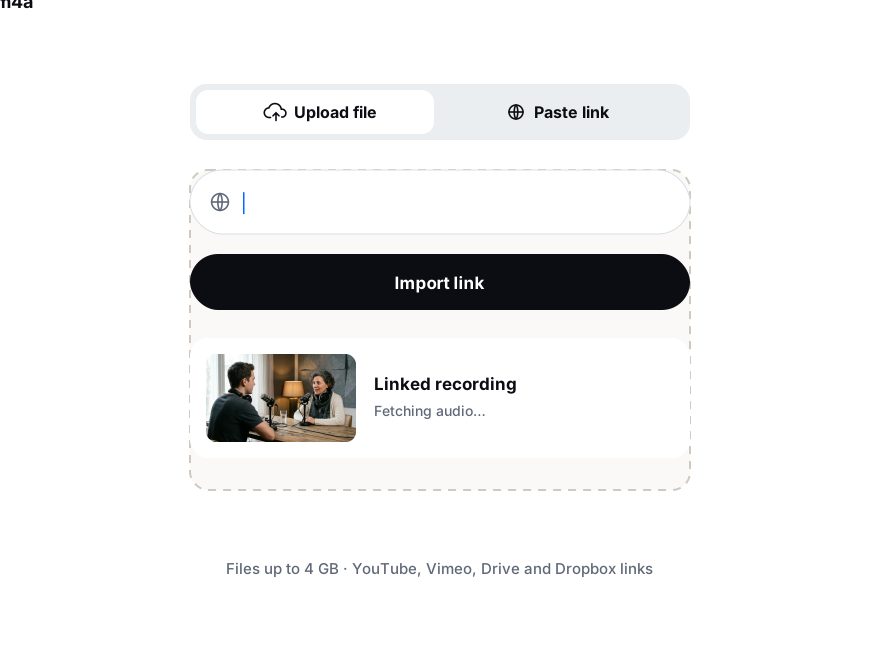
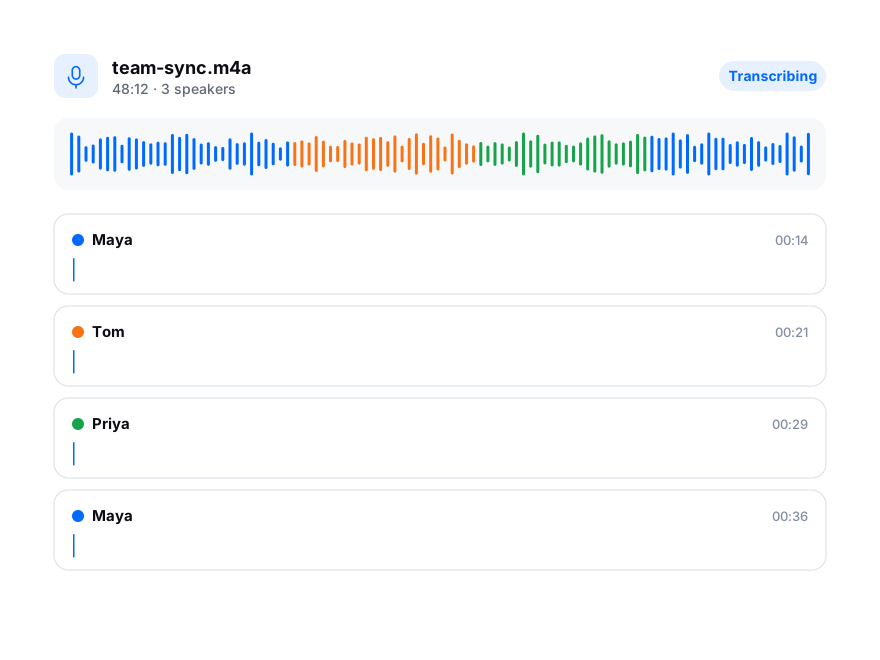
Add the audio or video file, or paste a link.
Fix names and terms while listening; rename speakers.
Pick DOCX, PDF, TXT, CSV, XLSX, JSON, SRT or VTT, and set names and timestamps.