Qualitative Research Transcription, Ready for Coding
Upload interviews or focus groups and get transcripts split by participant, with a timestamp on every turn, stored in the EU and never used to train AI, ready to code in your analysis tool.
Interviews, focus groups, field recordings · 120+ languages · files up to 8 GB
Participants become codes, not names
How did the diagnosis change your routine?
Mornings are planned now. Every single one.
I used to just get up and go.
Processed in the EU · never used to train AI
Click or drag & drop to upload your audio or videoTap to upload your audio or video
MP3, MP4, M4A, MOV, MKV, WEBM, AVI, WAV, FLAC, AAC, OGG, OPUS, WMA, WMV
No credit card required · Stored in the EU · Never used for AI training
Where Transcription Fits in a Qualitative Study


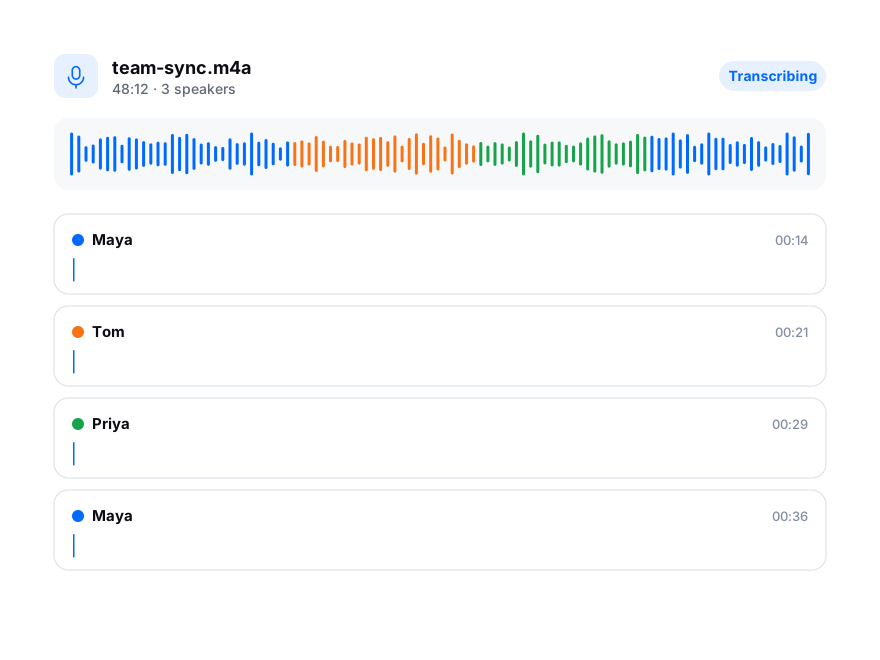
Each participant’s turns are labelled, so you can rename them to codes such as P04 and keep identities out of the transcript.
Speaker recognition separates up to five voices; you set the number before transcribing. In larger groups some participants share a label, so a moderator who names each speaker helps.
Transcribe in the participant’s language and add a translation for the team, with the same turns and timestamps in both.
Data Handling at a Glance
What ethics boards and data protection officers usually ask about, answered for this service.
- Where files are processed
- On our own servers in the EU (Germany); GDPR applies
- Used to train AI?
- No. Recordings and transcripts are never used for training and never sold
- In transit
- Encrypted between your browser and our servers
- Deletion
- Delete a file and its transcript at any time; free accounts keep files 30 days
- Pseudonymising participants
- Rename speaker labels to codes (P01, P02) before export
- Formats for analysis
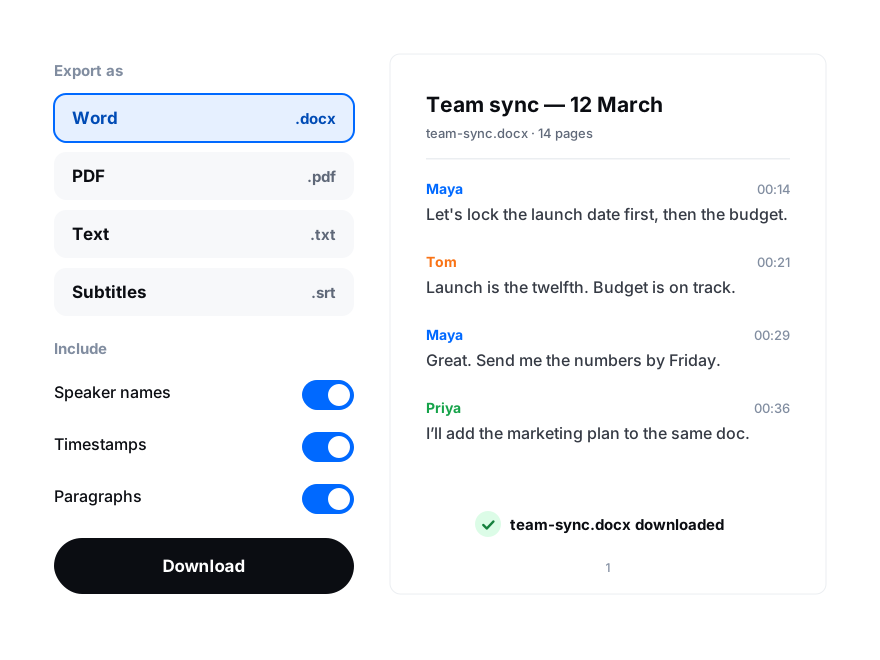
- DOCX for NVivo, ATLAS.ti or MAXQDA import; CSV or XLSX with one turn per row
Before You Transcribe Study Data
Three points worth settling before the first upload.
Consent
Mention the service in your consent form
If your protocol lists who processes recordings, name the transcription service and where it stores data. An EU-hosted service with no AI training on your files is simple to describe.
Identifiers
Rename speakers before you export
Replace names with participant codes in the editor and remove identifying details from the text, so the exported file is already pseudonymised.
Accuracy
Read every transcript against the audio
AI transcription is a first draft. Checking it while listening is also the first round of familiarisation with your data, which coding needs anyway.
How to Transcribe Research Interviews
From recording to finished text in three steps.
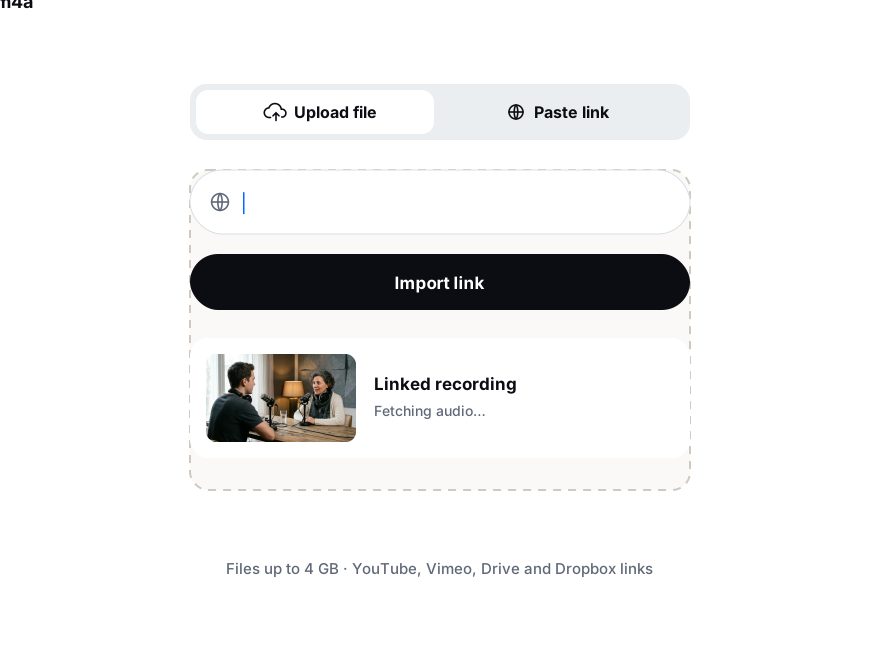
Add the interview or focus group recording, up to 8 GB per file, in its original format.
Turn on speaker recognition with the number of participants, then rename each voice to a participant code and correct terms in the editor.
Export DOCX for your analysis software, or CSV and XLSX with start and end times for every turn.