What Is Word Error Rate (WER) — and How to Read "99% Accuracy" Claims
Dzianis Kukareka, Founder · Updated
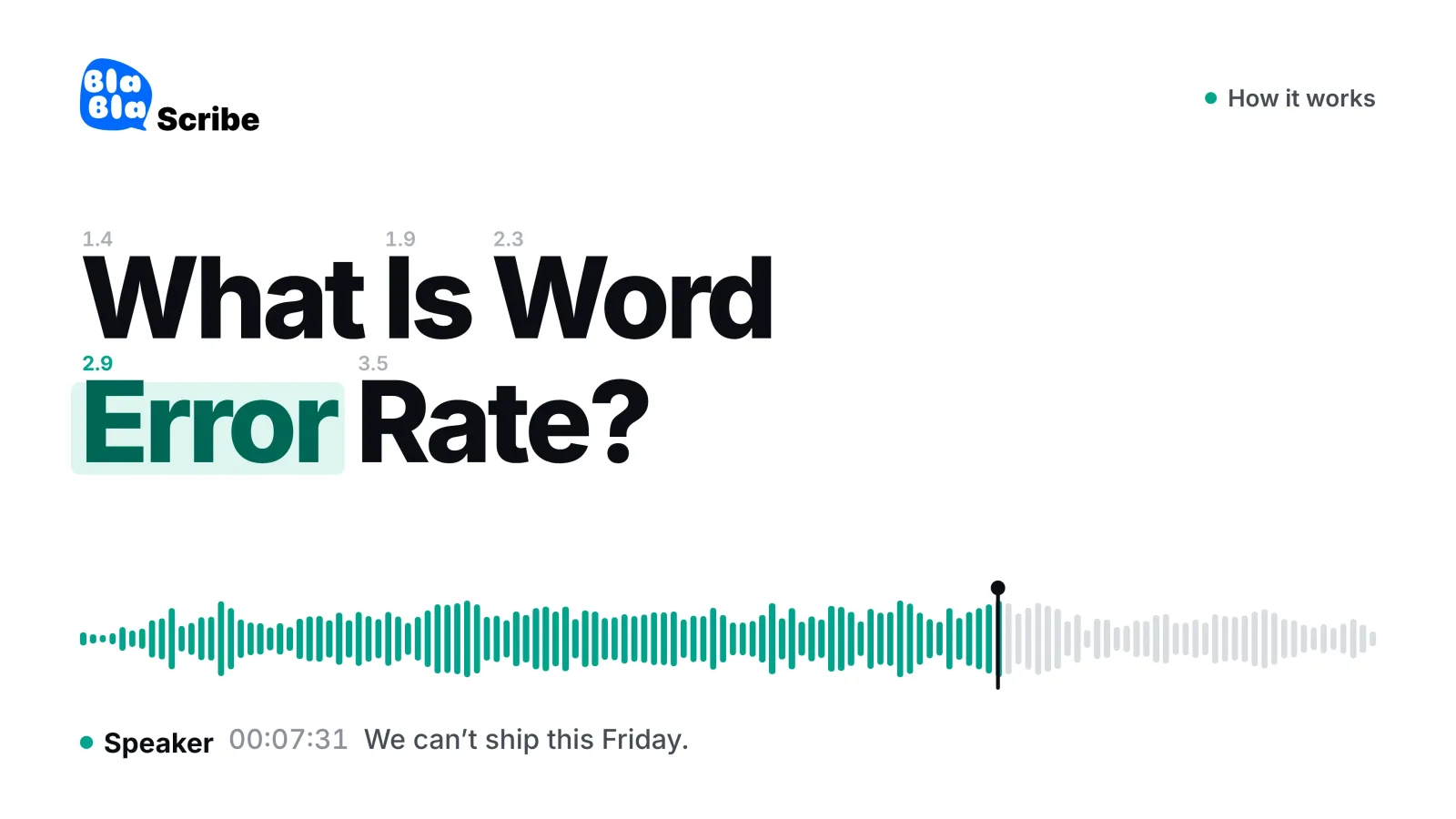
Word Error Rate (WER) is the standard yardstick of speech recognition: take a perfect reference transcript, compare the machine's output word by word, and count the mistakes. A WER of 5% roughly means "95% accuracy" — and that translation from metric to marketing is where the trouble starts. WER is a real, useful measure; the way it's quoted in ads is close to meaningless. Here's how the metric works, what it hides, and how to evaluate accuracy claims like someone who knows.
How WER is calculated
Line the machine's transcript against a human-verified reference and count three kinds of errors:
Substitutions — the wrong word: "their" for "there", "BlaBlaScribe" for "blah blah scribe".
Deletions — words the machine dropped.
Insertions — words it invented, often from background noise.
Then: WER = (S + D + I) ÷ N, where N is the word count of the reference. Ten errors in a 200-word reference = 5% WER. Because insertions count, WER can exceed 100% on garbage audio — a quirk that hints at the metric's literal-mindedness. (The metric's roots are in edit distance; the Wikipedia entry covers the formal definition.)
What WER hides
All errors weigh the same — but they don't
Dropping "um" and mangling the CEO's name are each one error to WER. To a reader, one is invisible and the other is a screenshot. Real transcripts live and die by which words are wrong — names, numbers, negations — and WER is blind to the difference. ("We can" vs "we can't" is one substitution.)
The number is meaningless without the test audio
The same system might score 4% WER on a podcast recorded in a studio and 30% on a phone recording of a windy press scrum. A vendor's "99% accurate" was measured on something — almost certainly clean, native-accented, single-speaker speech. Your audio is the only benchmark that predicts your results, which is the honest core of our guide to why transcription accuracy varies.
Normalization games
Before comparing, texts are normalized — casing, punctuation, "20" vs "twenty", filler words. Different normalization choices move WER by points. Published numbers rarely disclose their choices, which makes cross-vendor comparisons of headline figures mostly theater.
WER says nothing about the rest of the product
Speaker attribution errors, broken punctuation, timestamps that drift — none of it is in WER. A transcript with 3% WER and scrambled speaker labels is a worse work product than 5% WER with clean attribution. (Diarization has its own metric, DER, which vendors quote even less often.)
How to read an accuracy claim
A quick translation table for marketing language:
| The claim | What it usually means |
|---|---|
| "99% accurate" | ~1% WER on ideal audio, normalization undisclosed |
| "Human-level accuracy" | Matched humans on one benchmark's clean subset |
| "Industry-leading WER" | Won on some benchmark, possibly their own |
| "Up to 98.5%" | "Up to" is doing all the work |
None of these are lies, exactly — they're best-case numbers presented as typical. The tell of an honest accuracy discussion is conditions: what audio, what accents, what normalization.
The only benchmark that matters: yours
Testing beats reading. The procedure takes twenty minutes:
Pick one real recording — your usual mics, accents, crosstalk. Not the cleanest file; the typical one.
Run it through the tools you're comparing (free tiers exist for this — our free tools guide maps them).
Don't compute formal WER — read. Check the words that cost you: names, numbers, technical terms, negations. Count those errors.
Check the surroundings: speaker labels right? Punctuation readable? Timestamps clickable for verification?
Time the fix: minutes-to-publishable in each tool's editor is the metric your week actually feels.
Frequently asked questions
What's a good WER for AI transcription in 2026?
On clean, well-mic'd speech, leading systems sit in the low single digits — genuinely excellent. On hard audio (noise, heavy accents, overlap) WER climbs steeply for every system. There is no single honest number.
Is 95% accuracy good?
That's one error every twenty words — noticeable on every line of a dense transcript. Whether it's "good" depends entirely on which words are wrong and how fast the editor lets you fix them.
Why do vendors all claim ~99%?
Because best-case numbers on clean benchmarks land there, and nobody advertises their windy-parking-lot score. Treat converging claims as evidence the metric stopped differentiating, not that all tools are equal.
Does a lower WER always mean a better transcript?
Usually, on the same audio — but attribution, punctuation and editability decide the working value. Compare finished transcripts, not decimal points.
The bottom line
WER is a fine engineering metric and a poor purchasing guide. Know what it counts, notice what it ignores, and let one messy real recording — read with your own eyes — outvote every percentage in every ad.
Turn your recordings into text you can use
Upload audio or video, paste a YouTube link, or record in the browser — and get a speaker-labeled transcript in minutes, in 120+ languages.
Try BlaBlaScribe for freeNo credit card required · Files encrypted · Never used for AI training